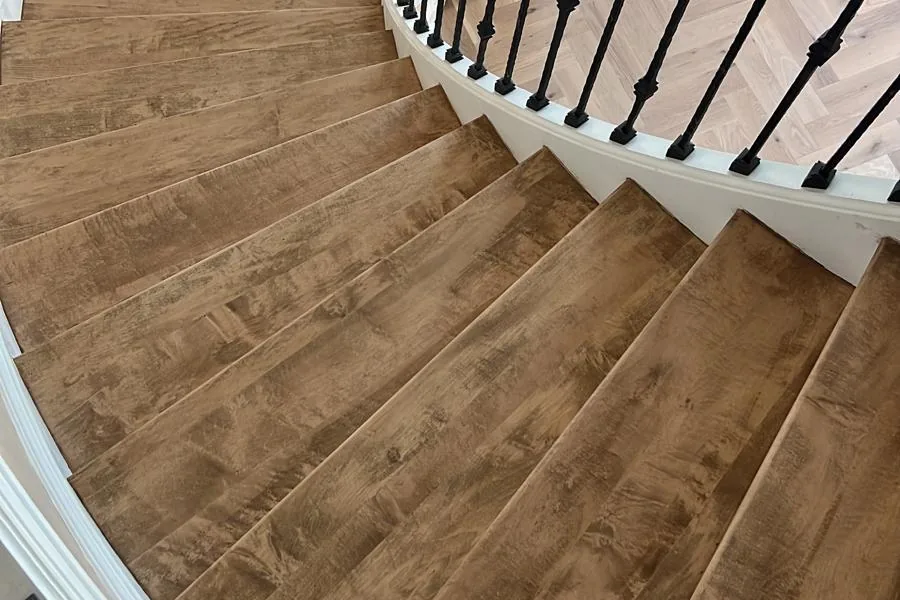
The short version
- Before anything else, find out what the stair is built from. Finished oak treads refinish well. Framing lumber that was built for carpet does not become a hardwood stair with stain.
- A stair cannot be sanded with a floor machine. It is hand work, tread by tread, and that is why a staircase takes longer per square foot than any room.
- Stain color is decided on samples made on your own sanded tread, next to the floors the stair connects.
- In the 635 places in our data at /data/, approximately 60.5 percent of housing predates 1978, and painted stair parts in those houses fall under the federal lead rule when sanded for pay.
- Refinishing changes how a railing looks. It does not make a railing meet the building code, and those are separate questions.
First find out what the stair is made of
A stair can be refinished when it was built as a finished stair, with hardwood treads and a shaped nosing, and it cannot when it was built from framing lumber to be covered with carpet.
This is the step people skip. They lift a corner of the carpet, see wood, and plan a refinishing budget. A stair built for carpet is usually made of plain softwood boards with a square front edge and gaps at the sides, because none of it was meant to be seen. Sanding and staining it gives you a stained piece of construction lumber.
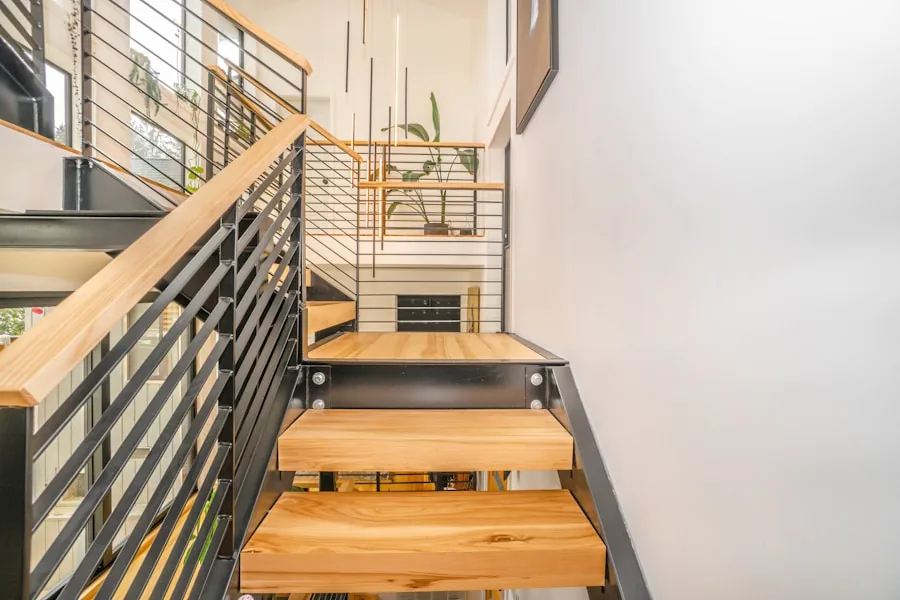
A finished stair looks different once you know what to look for. The tread is hardwood, most often oak, about an inch thick, with a rounded nosing that projects past the riser below. The joints at the wall side are tight. If the stair is open on one side, you can see the end of each tread and its return.
We lift the carpet at one tread before quoting. If the stair is finished oak, the job is refinishing. If it is construction lumber, the job is new treads and risers, and that is a different service with a different number.
Wood under the carpet is not the same as a hardwood stair under the carpet. One tread, uncovered, answers the question.
Why a stair is sanded by hand
A floor sander cannot work on a surface ten inches deep with a wall on one side and a baluster on the other, so every part of a stair is sanded with small machines and by hand.
On a floor, a drum sander covers the open area in long passes and an edger handles the perimeter. On a stair there is no open area. Each tread is sanded with a small orbital machine, the corners and the joint at the riser are scraped and sanded by hand, and the nosing is worked by hand so its curve is kept.
The grit sequence is the same as on a floor, coarse to fine with no step skipped, and for the same reason: each grit removes the scratches left by the one before. A skipped grit on a stair shows clearly, because treads are seen at close range and in side light from a window or a landing.
Balusters and handrails take the longest. Turned balusters have profiles that only hand sanding reaches, and a handrail has to be cleaned thoroughly first, since years of hands leave oils that stop a new finish from gripping where the rail is touched most.
Staining treads to match the floors
The color is chosen on samples made on your own sanded tread, viewed beside the floor at the top and the floor at the bottom.
A stair connects two floors, and they are not always the same age or color. The stain that matches the hall downstairs may clash with the bedrooms upstairs. Deciding from a color chart does not work, because the same stain looks different on every species and on wood of different ages.
Most stairs in this region are red oak, which has a pink undertone that shows through many colors, particularly the cooler browns and grays. That is tested on a sample, not assumed. White oak takes the same stains more neutrally, and old heart pine goes dark quickly and unevenly.
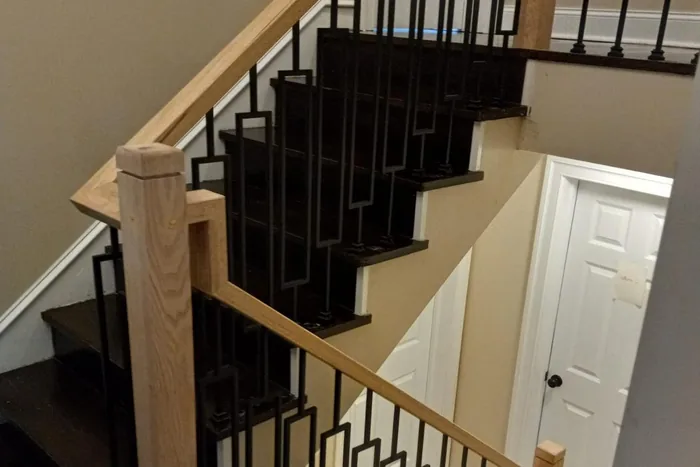
A common and good looking arrangement is stained treads and handrail with painted risers and balusters. It keeps the grain where feet and hands go and it limits the detailed hand sanding to the parts that will show wood.
| Part | How it is prepared | Usual finish |
|---|---|---|
| Treads | Sanded to bare wood through the full grit sequence | Stain if wanted, then floor finish in coats |
| Risers | Sanded to bare wood if stained, or prepared for paint | Paint, or stain to match the treads |
| Handrail | Cleaned, then sanded by hand along its profile | Stain and a hard clear finish |
| Balusters | Hand sanded, or scuffed for repainting | Paint in most houses, stain where the wood is good |
| Newel post | Checked for movement first, then sanded | Matches the handrail |
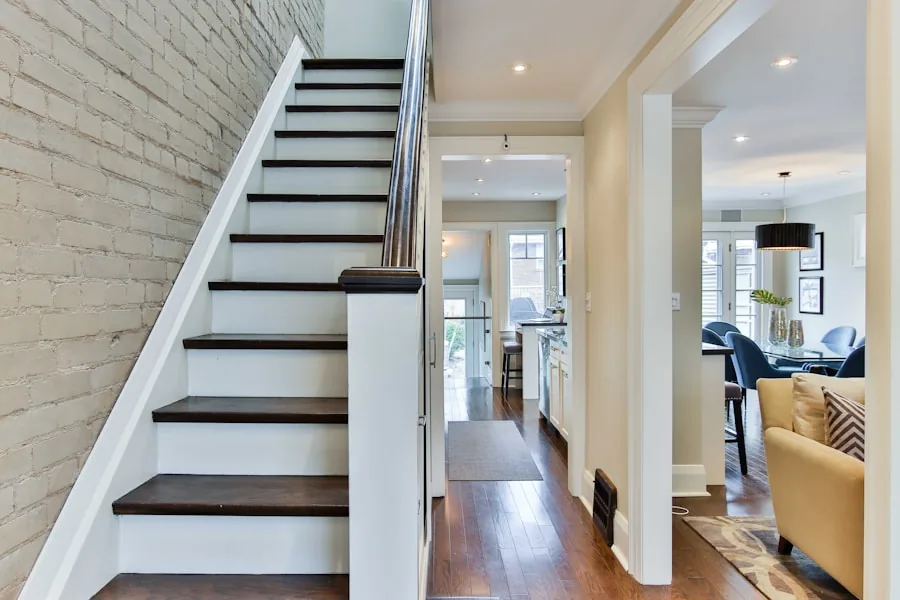
Painted risers and balusters in a house built before 1978
When painted stair parts in a pre-1978 house are sanded for pay, the federal lead renovation rule applies, and it governs how the work area is contained and how the sanders are built.
The rule is 40 CFR Part 745. It covers paid work that disturbs painted surfaces in housing built before 1978, and a staircase is one of the most heavily painted assemblies in an old house: risers, stringers, balusters and often the treads themselves under the carpet.
Across the 635 towns and Philadelphia neighborhoods in the dataset we publish at /data/, approximately 60.5 percent of 3,899,409 housing units predate 1978. In Philadelphia it is approximately 82.8 percent, and in 45 of the city's 132 neighborhoods it is above 90 percent. In most of the houses where we refinish stairs, this is the normal condition of the job.
In practice it means the stair is contained with plastic at the top and bottom where the layout allows, the sanders are connected to a vacuum, and the cleanup follows a set method. A stair is open to two floors, so this is planned at the estimate.
If you do not know what year your house was built, the county property record usually states it. It is worth checking before the estimate.
Living in the house while the only stair is being finished
The work is staged so the stair can still be used, and the finish is chosen with the cure schedule in mind, because walkable and cured are two different points.
Sanding days are the easy part: the stair is usable in the evening once the dust is cleared. The finish coats are the constraint. One approach is to coat every other tread, let those dry, and then coat the rest, so there is always a dry step to use. Another is to coat at the end of the day and keep everyone on one floor overnight.
Waterborne finishes dry faster between coats and stay close to the natural color of the wood. Oil modified polyurethane takes longer and adds an amber tone that deepens with age. Either one can be walked on in socks well before it has fully hardened, and that is when a stair gets damaged: shoes, pets and a suitcase dragged down too early.
We give the schedule in writing before the job starts, with the day the stair can take socks, the day it can take shoes and the day a runner can go back down.
Sheen, and why it matters more on a stair
A satin finish hides wear better than gloss on a surface that takes this much traffic, and it is less slippery underfoot.
Sheen does not change how hard a finish is. It changes how much the surface reflects, and a reflective surface shows every scuff, every scratch and every footprint. On a stair, where each tread is hit in the same place thousands of times a year, gloss looks worn within months.
Traction is the other reason. A glossy tread in socks is a real hazard on the way down. A satin or matte sheen gives more grip, and a carpet runner fitted after the finish has cured adds more where there are children or older people in the house.
We show both sheens on a sample before you choose. It is a small decision that people live with every day.
Refinishing does not make a railing meet code
Sanding and staining a handrail changes how it looks, and it changes nothing about its height, its graspability or the gaps between the balusters.
Old stairs were built to the practice of their time. Philadelphia now adopts the 2021 International Residential Code, under which a handrail sits between 34 and 38 inches above the line of the tread nosings and openings in a guard must not pass a 4 inch sphere. Many original railings in this housing stock are lower than that, with wider gaps.
Refinishing an existing railing is generally treated as repair, and replacing one is generally held to the current code. The rules are adopted locally, and towns in Pennsylvania, New Jersey and Delaware do not all use the same edition, so the answer for your address comes from your code office.
We raise this at the estimate because it affects what is worth spending. Detailed hand sanding on a railing that you intend to replace within a few years is money better put toward the new one.
When a tread should be replaced
A tread is replaced when it is cracked through, worn too thin in the middle, or when sanding it level would take too much from the edges.
A century of feet wears a hollow in the center of each step. On a thick oak tread a shallow hollow can be sanded out. A deep one cannot, because leveling it means removing the same depth from the whole tread, and the nosing ends up thin and weak.
A replacement tread is cut to the opening it goes into, since no two openings in an old stair are the same size, and it is finished with the rest so the color matches. New oak next to old oak reads slightly lighter at first and moves closer as it ages.
If more than a few treads need replacing, it is worth pricing new treads for the whole flight. At that point the work is closer to a stair conversion than a refinish, and the result is more even.