
Stairs & Railings
Handrail & Railing Installation in Philadelphia, PA
A railing is two different things wearing one name. The handrail is what your hand slides along, and it has rules about height and about the shape your fingers close around. The guard is what stops someone going over the open side, and it has rules about height and about how large an opening between balusters is allowed to be. Both are in the building code, and stairs are where an inspector looks hardest.
In short
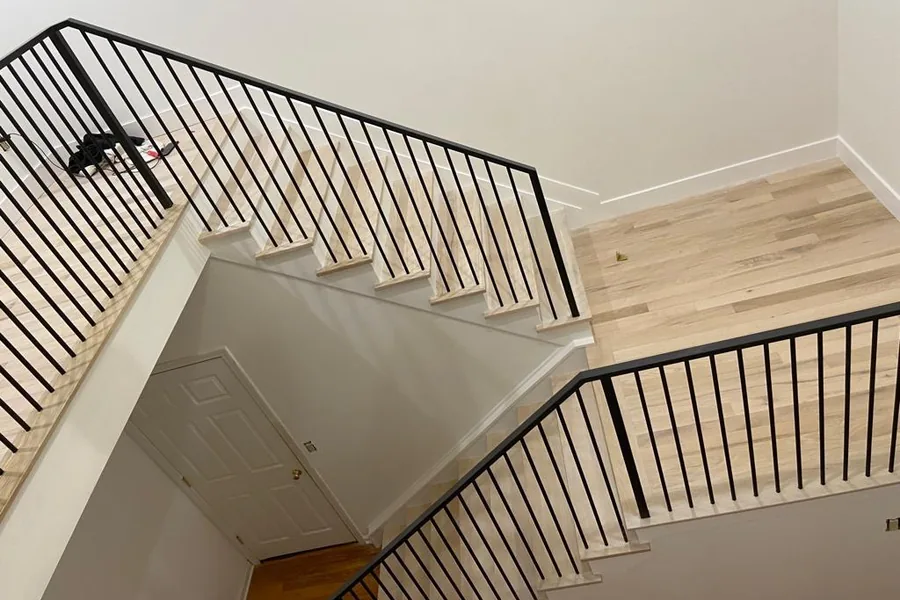
Deco Hardwood Floor installs handrails and stair railings for homeowners in Philadelphia and within 50 miles of it, drawing and building each one in house. Stair railing installation covers the handrail, the balusters, the newel posts and the anchoring into structure that keeps them rigid. It is the right call when a railing moves under a hand, when balusters are missing or too far apart, or when a remodel has opened a side of the stair. The result is a railing checked twice, once as a handrail and once as a guard, against the code adopted where the house is.
At a glance
- What it is
- Handrail, balusters, newel posts and the anchoring nobody sees
- Two systems, one name
- The handrail you hold and the guard that stops a fall are governed separately
- Common trigger
- A stair opened up in a remodel, or a railing that moves when you lean on it
- Code applies
- Rail height, graspability, guard height and baluster spacing are all specified
- Material
- Wood, or wood rail with iron balusters. Supplied by us
Handrail and guard are not the same thing
The handrail is the graspable rail your hand runs along; the guard is the barrier on an open side. They are governed by separate provisions and a railing can satisfy one and fail the other.
This distinction is the reason a railing that looks finished can still be wrong. A beautiful heavy rail can be too thick to actually grasp, which is a handrail failure. A perfectly graspable rail can sit above balusters spaced wide enough for a toddler, which is a guard failure. They are different tests.
The code sets a range for how high the rail sits above the nosing of the treads, a minimum height for the guard on an open side, a maximum opening between balusters, and a description of what counts as graspable. We build to the version of the code as adopted locally rather than to a number remembered from another job.
Where the design someone wants conflicts with any of that, the code wins and we say so at the drawing stage. That conversation is much cheaper than the one at inspection.
If a railing moves when you lean on it, that is not a tightening job. It is almost always the newel post anchoring, and it is underneath the finished surface.
The newel post is the whole railing
Everything a railing has to resist ends up at the newel posts, so how they are anchored to the framing decides whether the railing is solid in ten years.
A handrail run is only as rigid as its ends. A newel that is face screwed to a tread will feel fine on the day it is installed and will work loose, because the load is a person's weight applied sideways at the top of a lever.
Anchoring properly means getting to structure: fastening into framing, or using hardware designed to develop that connection through the tread and into the stringer or a blocked bay below. Which of those applies depends on how the stair was built, and it is one of the things we look for when the stair is open.
This is invisible work. It is also the difference between a railing that a house grows old with and one that is wobbling by the time the finish has cured.
Retrofitting a railing to a stair that already exists
Adding or replacing a railing on a finished stair is possible, and how invasive it is depends entirely on whether the balusters land in the treads or in a shoe rail.
Where balusters sit in holes drilled into the treads, replacing them means the tread is involved: plugging, patching or replacing, and then blending the repair into a finish that has been on the stair for years. Where they sit in a shoe rail between two posts, the whole assembly can often come out and go back without touching the treads at all.
Iron balusters change this calculation, because they are usually set into a shallower hole and epoxied, which makes a wood-to-iron conversion one of the least invasive upgrades available on an existing stair.
We look at the connection before quoting, for the same reason we look under the carpet: the answer changes the job by a large factor and it is not visible from standing height.
When does a stair railing need to be replaced?
A stair railing needs work when it moves, when it cannot be gripped, or when a child could fit through it. Those are three separate failures, and a railing can have one without the others. Each sign below can be checked by hand in a minute.
The post moves when you lean on it
Push sideways on the newel post at the bottom of the stair. Any movement means the post is not anchored to structure, and tightening what is visible will not last.
Gaps a small child could fit through
Measure the widest gap between balusters. In the Pennsylvania Residential Code a required guard may not have an opening that passes a 4 inch sphere, and the reason is small children.
A rail too thick to close a hand on
Wrap your hand around the rail. If your fingers cannot close on it, it fails as a handrail, however solid it is. Graspability is a requirement, not a preference.
A rail that stops short
The handrail ends before the top or bottom step, or breaks at a turn. A handrail is meant to run the full flight, so a hand has it on every step.
An open side with nothing on it
A remodel removed a wall and left the side of the stair open, or a railing came down and never went back. An open side above a drop needs a guard.
Loose or missing balusters
One or more balusters rattle, turn in place or are gone. A missing baluster widens an opening in the guard, and a loose one means its joint at the tread or rail has failed.
How the work runs
The stair gets measured
Rise, run, the line of the nosings, and how far out of square the opening is.Handrail and guard checked separately
Two sets of requirements, tested as two things.Drawing agreed
Profile, baluster pattern and post positions, before material is ordered.Newel anchoring solved first
The connection to structure, decided by how the stair was built.Rail and balusters fitted
Cut to the actual stair, not to a nominal drawing.Finish
Stained to match where it meets the floor, then coated.
What is included in a handrail and railing installation
A railing installation includes measuring the stair, a drawing, the material, the anchoring of the newel posts, and the fitting and finishing of rail and balusters. Repairs to treads disturbed by old balusters depend on how those were set, and are priced once we have seen the connection.
Included
- Measuring rise, run, the line of the nosings and how far out of square the opening is.
- A drawing of rail profile, baluster pattern and post positions, agreed before material is ordered.
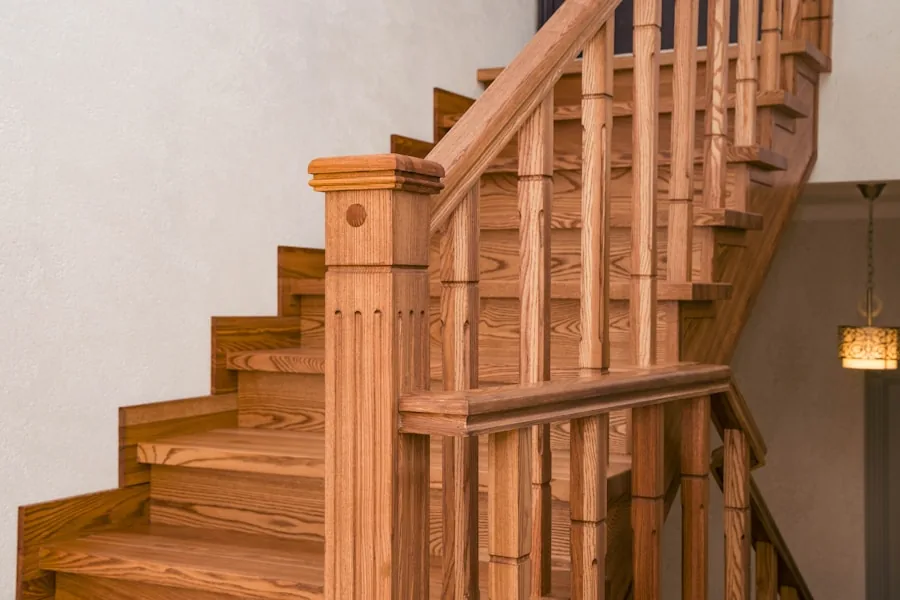
- Handrail, balusters and newel posts supplied by us, in wood or with iron balusters.
- Newel posts anchored to structure, not screwed to the face of a tread.
- Handrail and guard checked separately against the code adopted where the house is.
- Stain matched on a sample where the railing meets the floor, then finish coats.
Not included, or quoted separately
- A firm price before we have seen how the existing balusters and posts are set.
- A design that conflicts with the building code. Where the two disagree, the code wins.
- New treads or risers. Those are stair installation, drawn together with the railing when both are needed.
What changes the price of a stair railing installation
The price is set after we see the stair and how the existing railing is attached to it. It moves most with the length of the run, with how the balusters are set, and with what it takes to anchor the newel posts to structure.
| What changes it | How it moves the price | Example |
|---|---|---|
| Length and shape of run | More rail means more balusters and more fitting. Turns, landings and level sections at the top add posts and joints in the rail. | A straight rail between two posts is the simple case. A stair with a landing and a level run above it is not. |
| How the balusters are set | Balusters drilled into the treads involve the treads in any replacement. Balusters in a shoe rail can often come out without touching them. | Replacing balusters set in tread holes can mean plugging or patching each tread and blending the repair into an old finish. |
| Newel post anchoring | Reaching framing, or fitting hardware through the tread into the stringer or blocking, depends on how the stair was built. | A post that can be fastened straight into framing is quicker to anchor than one that needs a blocked bay built below it. |
| Wood or iron balusters | Material and labor both differ. Iron balusters are usually set in a shallower hole with epoxy, which makes them less invasive on an existing stair. | Keeping the wood handrail and changing wood balusters to iron is one of the least invasive upgrades available. |
| Rail profile and fittings | A straight length of rail is the least work. Curved sections and the fittings that carry a rail around a turn take more layout and cutting. | A continuous rail that turns at a landing needs fittings shaped to the turn. A rail that stops at a post does not. |
What to ask before hiring a stair railing installer
Ask these six questions of any railing installer, including us. A railing is the part of a staircase where a mistake injures someone, and most of what makes it safe is hidden once the work is finished.
How will the newel posts be anchored?
A good answer mentions framing, blocking or hardware that goes through the tread into structure. A post screwed to the face of a tread feels solid on the first day and works loose.
Which code version are you building to?
Philadelphia adopts the 2021 International Residential Code with local amendments. Other Pennsylvania towns, New Jersey and Delaware differ. A contractor should name the one that applies to your address, not a number from memory.
Do you check the handrail and the guard separately?
They are two requirements on one assembly. A rail can be the right height and still sit over balusters spaced too wide. Someone who treats them as one thing will miss one.
Can I see a drawing before material is ordered?
The drawing shows rail profile, baluster pattern and post positions. It is where a conflict between the design and the code gets caught, while the fix is still a line on paper.
How are my existing balusters set?
Balusters in tread holes and balusters in a shoe rail are very different jobs to replace. A quote given without checking the connection will change once the first baluster comes out.
Is the rail you are proposing graspable?
A wide, flat or heavy rail can look right and fail as a handrail because a hand cannot close around it. The contractor should be able to show the profile and explain why it qualifies.
Why homeowners hire Deco Hardwood Floor
Deco Hardwood Floor is owner operated: the person who quotes handrail & railing installation is the person responsible for it, and the material comes with the labor in one number.
Material and labor in one number
We buy the flooring direct from the distributor and pass the store price through, so you are not sourcing wood on your own between quotes.
Samples come to your house
Samples and larger offcuts come to you, so the color gets chosen in your own light instead of under a showroom lamp.
Stairs and railings built in house
Treads, risers, handrails and newel posts are drawn and built by our own crew. Most flooring crews subcontract stair work or decline it.
The owner quotes the job
The person who measures your floor is the person responsible for the work. There is no salesperson in between.
Measured before it is promised
Remaining thickness is measured at the edge of a board before we say a floor can be sanded, and no price is firm before we have seen the room.
Told straight, including the limits
Vacuum extraction catches most of the sanding dust and not all of it. We tell you that before the job instead of after.
More about who we are and what we will not claim on the About Deco Hardwood Floor page.
Questions about handrail & railing installation
Our railing wobbles. Can it just be tightened?
Rarely. A railing that moves is normally a newel post that was never anchored to structure, and the fix is at the connection, underneath the finished surface. Tightening what is visible buys a few months.
Can we keep the handrail and only change the balusters?
Often yes, and swapping wood balusters for iron is one of the least invasive changes available on an existing stair. Whether the treads get involved depends on how the existing balusters are set.
Do you build to the code?
Yes, to the version adopted locally. Rail height, graspability, guard height and baluster spacing are all specified, and where a design conflicts with them we say so at the drawing stage.
Can you match the railing to my floor?
We match where the two meet, and we test it on a sample. Rail and baluster stock is often a different species than the floor and takes stain differently.
Do you do the stair itself as well as the railing?
Yes. Treads, risers, stringers and skirt board are the same job, and doing both means the two are drawn together rather than negotiated between two crews.
Wood or iron balusters: which should we choose?
Choose by the look you want and by how the stair is built, since both can meet the code. Wood balusters are stained or painted to go with the stair. Iron balusters are usually set in a shallower hole with epoxy, which makes them less invasive to fit on an existing stair. In a stair railing installation, either kind has to keep the openings within the limit for a guard.
How high does a stair handrail have to be?
The Pennsylvania Residential Code 2021 sets handrail height at 34 to 38 inches, measured vertically from the sloped line of the tread nosings. Philadelphia adopts the 2021 International Residential Code with local amendments, and New Jersey and Delaware adopt their own codes, so the number is confirmed for the address. On a handrail and railing installation, Deco Hardwood Floor builds to the version adopted where the house is.
Can we use the stairs during a railing installation?
In most cases the stair stays walkable, with care. During a stair railing installation the open side has no guard between the old railing coming out and the new one being fitted. That matters most with small children and pets, who should be kept off the stair during that stage. Stain and finish on the rail also need to cure before hands go on it.
What can go wrong with a railing installation?
The failures are a post that loosens, openings that are too wide, and a rail a hand cannot grip. The first comes from fastening a newel to a tread instead of to structure. The other two come from building to the look instead of the code. In a handrail and railing installation none of these shows on the day the work is finished, which is why the questions get asked at the drawing.
Should the railing be done at the same time as the stairs?
Yes, when both are being worked on. Balusters on an open stair land in the treads, so new treads and a new railing affect each other. Deco Hardwood Floor draws the two together in that case. If the stair is staying as it is, a handrail and railing installation can be done alone, and how invasive that is depends on whether the balusters sit in the treads or in a shoe rail.
Railings terms, defined
- baluster
- One of the upright members between the handrail and the treads or shoe rail. Together they fill the open side of a stair, and their spacing is limited by the building code.
- newel post
- The heavy post at the start, end or turn of a railing. Everything the railing has to resist ends up there, so its anchoring to the framing decides how rigid the rail is.
- handrail height
- The vertical distance from the sloped line of the tread nosings up to the rail. The Pennsylvania Residential Code 2021 sets it at 34 to 38 inches. New Jersey and Delaware adopt their own codes.
- guard
- The barrier on the open side of a stair, landing or balcony that stops a fall. It has its own minimum height and opening limit, separate from the handrail rules.
- graspability
- The requirement that a handrail have a shape and size a hand can close around. A rail can be strong and well finished and still fail it by being too wide.
- 4-inch sphere rule
- The limit on openings in a required guard: none may let a sphere 4 inches in diameter pass. It is section R312.1.3 of the Pennsylvania Residential Code 2021, and it exists to protect small children.
The rules behind this work
From the blog
Refinishing and staining hardwood stairs
A staircase is the smallest floor in the house and the slowest one to refinish. What is under the carpet decides whether it can be done at all.Stair railing height: the code in PA, NJ and Delaware
Handrail and guard are two requirements on one railing, and the edition of the code that applies depends on which side of the river the house is on.
Related work
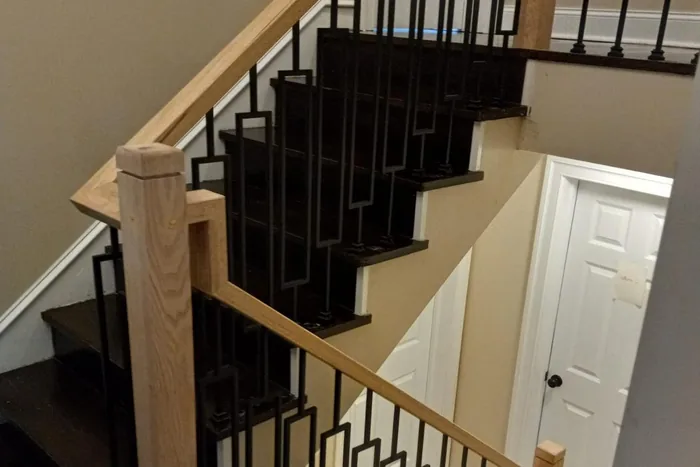
Custom Stair Installation
Treads, risers, stringers and skirt board, built to a drawing instead of a catalog page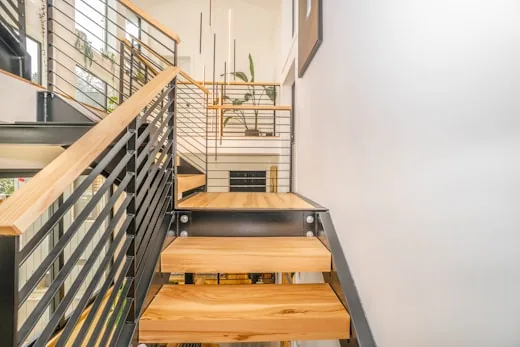
Carpet to Hardwood Stairs
Pulling carpet off a staircase and finding out what is underneath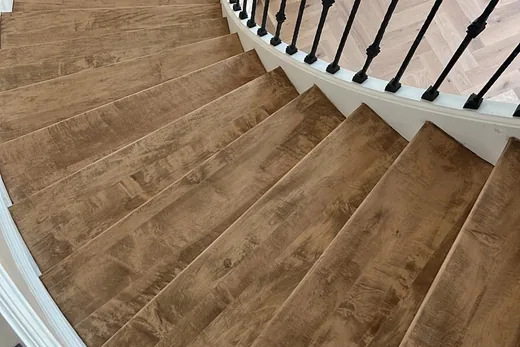
Stair Refinishing
Stairs take more wear per square foot than any floor in the house, and they are sanded almost entirely by hand
Send a photo and we will tell you what you are looking at
Handrail & Railing Installation starts with someone reading the house. We quote every job ourselves, with no salesperson in between, and a photo of the floor gets you a straight answer faster than a form does.
