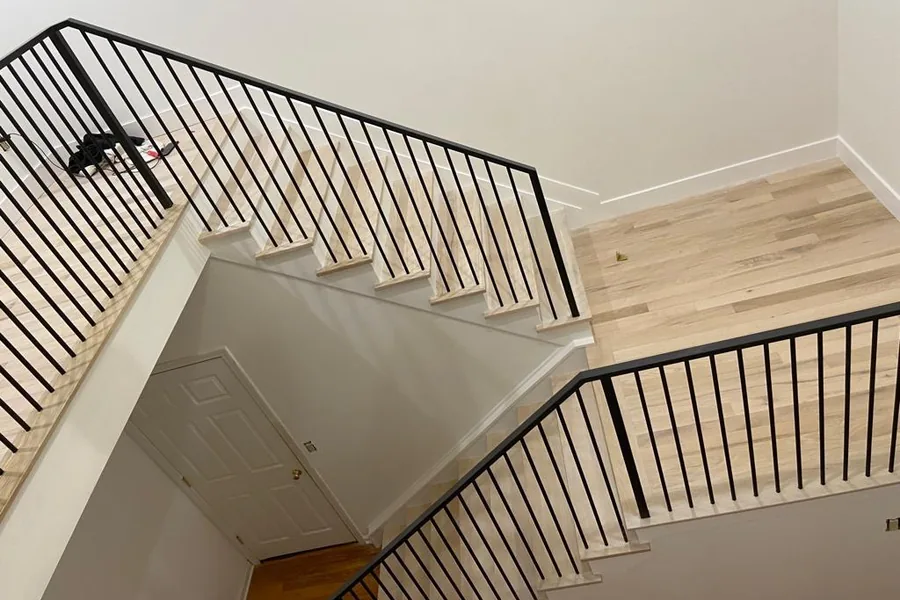
The short version
- A wobbly railing is almost always one failed joint, and a simple push test finds which one.
- A newel post that rocks at the floor is the serious case: the fix is at the connection to the framing, not at the visible screws.
- A rail that moves where it meets the post is often a rail bolt that can be tightened, if the wood around it is sound.
- A single rattling baluster is usually a small repair, but a missing one changes the opening the guard is meant to limit.
- Philadelphia housing is old: approximately 82.8 percent predates 1978, by our dataset at /data/, so most railings in the city are older than the rules they are compared to.
First find out which part is moving
Push the rail sideways at several points and watch the joints: the base of the newel, the rail at the post, each baluster and each wall bracket. The one that moves is the repair.
Stand at the bottom of the stair and push the top of the newel post sideways, firmly, the way someone would lean on it. Then grip the rail halfway up and push again. Then run your hand along the balusters and give each one a twist. If there is a wall rail, pull on it next to each bracket.
Watch rather than feel. A newel that rocks will show a gap opening at its base. A rail that moves at the post will show a crack opening at the joint. A loose baluster turns in its hole or lifts at the top. A bracket pulling out of the wall shows a crack in the plaster around its plate.
A short phone video of this test, with the joint in frame, is the most useful thing you can send before an estimate. It usually tells us which of the cases below we are looking at.
| What moves | Where the fault usually is | What the repair involves |
|---|---|---|
| Newel post rocks at the floor | Connection between the post and the stair or floor framing | Re-anchoring to structure, sometimes through the tread or from below |
| Rail moves where it meets the post | Rail bolt or joint between rail and post | Tightening the bolt if the wood is sound, rebuilding the joint if not |
| One baluster turns or rattles | The baluster's joint in the tread or the rail | Glue and pin, or a new baluster |
| Many balusters loose | Shrinkage over decades, or a weak rail | Resetting balusters, sometimes a new rail |
| Wall rail pulls away | Bracket screws in plaster or old masonry plugs | Moving brackets to framing or proper masonry anchors |
A newel post that rocks at the floor
This is the serious one, because the newel is the anchor the whole railing pulls against, and the repair is at its connection to the framing under the finished surface.
Everything a railing resists ends at the newel posts. When someone leans on the rail, the force travels along it and tries to tip the post over. The post is a lever, and the joint at its base takes the load multiplied by its height.
Newels on many older stairs were attached to the bottom tread and riser, sometimes with a long bolt into the framing, sometimes with little more than nails. Decades of leverage loosen that. Screws driven through the side of the post into the tread may hold for a few weeks, then loosen again, because they are fighting the same lever in a thin piece of wood.
A lasting repair reaches structure. Depending on how the stair was built, that means fastening into a joist or blocking from below, where there is access through an unfinished ceiling, or using hardware made for anchoring newels that goes through the tread into the framing. Sometimes a tread or riser has to come off to get there. We decide which once we can see how the post is attached.
If the newel moves, do not let anyone use the rail for support on the stairs until it is fixed. It is the one part of the railing that is supposed to never move.
A rail that moves where it meets the post
The rail is usually joined to the newel with a rail bolt, and if the wood around it is sound, tightening that bolt is a real repair rather than a patch.
A common way to join a handrail to a newel is a rail bolt: a bolt threaded at both ends, screwed into the post on one side and drawn tight into the rail with a nut reached through a small hole drilled under the rail. The hole is then plugged, so most people never know it is there.
When that joint loosens, finding the plug, reopening the access hole and drawing the nut tight again can close the joint completely. It is one of the few railing problems where tightening is the honest answer.
It stops working when the wood itself has failed: a split in the rail end, threads stripped out of the post, or a previous repair with glue and finishing nails that broke the joint apart. Then the joint is cut back to sound wood and rebuilt, which on an old rail can mean a new section of rail matched to the profile.
Balusters that rattle or turn
A single loose baluster is usually a small repair. The concern is a missing or broken one, because the spacing between balusters is what keeps a child from slipping through.
Balusters are fixed at both ends. At the top they are usually fitted into the underside of the rail and nailed or pinned. At the bottom they sit in a hole in the tread, in a shoe rail between the posts, or, on many older stairs, in a dovetail cut into the end of the tread and hidden under the return nosing.
Wood shrinks over decades, and the joints loosen. A baluster that turns in its hole can usually be glued and pinned back in place. One that is cracked or split is replaced with a matching profile, which on older stairs often means having it turned to match.
If many balusters are loose at once, the cause is usually the rail moving, not the balusters. Fixing them one by one without solving the rail just loosens them again. And if a baluster is missing, the opening in the guard is now wider than it was designed to be. Our article on stair railing height and the code explains the limits that apply in Pennsylvania, New Jersey and Delaware.
Wall rails pulling out of plaster or brick
A wall rail is only as strong as its brackets' grip on the wall, and in old houses the brackets are often screwed into plaster and lath or into masonry plugs that have loosened.
A wall rail is held by brackets screwed into the wall every few feet. In a house with plaster walls, a bracket that missed the framing is held only by the lath, and it will work loose. In a rowhouse, the stair often runs along a brick party wall, and brackets anchored with old plugs in the mortar loosen as the plugs dry and crumble.
The fix is to anchor each bracket into something solid: the wall framing, found and marked before drilling, or masonry anchors set into the brick itself rather than the mortar joint. Sometimes that means moving a bracket a few inches and patching the old holes.
This is a small job that matters more than it looks. People pull on a wall rail harder than on any other part of a stair, usually at the moment they lose their footing.
When a repair becomes a replacement
Repair restores what was there. A rail that is rotted or split along its length, a newel that is cracked, or a railing that was never adequate to begin with is usually replaced.
Most railings can be repaired, and in an old house repair keeps the original wood and profile, which is often worth a great deal. But some cannot. A rail split along its length, a newel cracked through or eaten by insects at the base, or a railing that has been repaired so many times with glue and screws that there is nothing sound to fasten to.
There is also the railing that was never right: too low, too thick to grip, with balusters spaced wide. A repair restores what was there, including what was wrong with it. A new railing is built to the code as adopted locally, and when an owner is choosing between repairing an inadequate railing and replacing it, that difference is part of the decision.
Partial replacement is often possible. A sound rail can be kept and the balusters changed, and swapping wood balusters for iron is one of the least invasive upgrades on an existing stair.
Why tightening the visible screws does not last
Because the failed joint is usually hidden, and screws driven into the visible parts are fighting the leverage of the whole railing in thin wood or end grain.
The common first attempt is a longer screw through the side of the newel, or a few nails into a loose baluster. It feels solid for a while. Then the railing loosens again, often worse, because each new screw hole leaves less sound wood for the next one.
The joints that hold a railing are designed to be hidden: the rail bolt under the rail, the newel anchor under the tread, the baluster dovetail under the nosing. Fixing the railing means getting to those joints.
If a railing has already been through a few rounds of extra screws, say so at the estimate. It changes what we look for, and it often explains why it keeps coming back.
Old coatings and painted railings
Many railings in older houses are painted, and sanding or scraping paint in a home built before 1978 falls under the federal lead rules unless testing shows no lead.
A railing repair often ends with refinishing the part that was repaired so it matches the rest. On a painted railing in an older house, that means disturbing paint that may contain lead.
The federal rule for renovation in pre-1978 homes covers that kind of work: containment, careful dust control and cleaning, unless a test shows the coating is free of lead. With approximately 82.8 percent of Philadelphia housing built before 1978, it is the normal case in the city rather than the exception.
It does not make the repair much harder. It does mean the plan for the finish is part of the estimate, not an afterthought.