

Seasonal gaps are the floor working, not the floor failing
Every February we get calls about gaps that were not there in September. In a solid wood floor that is normal behaviour and not a defect: boards give off moisture in dry indoor air and shrink, and they take it back and swell when the humidity comes up. The useful question is not whether your floor gaps. It is whether the gaps close, and in a region where 60.5 percent of the housing predates 1978, the floors doing this are often on their third or fourth generation of doing it.
The short version
- Gaps that open in winter and close in summer are the floor working normally.
- A gap that stays open through a humid August is a different problem and worth looking at.
- Cupping, where board edges rise above the middle, means moisture is coming from below.
- Crowning, the opposite, usually means a cupped floor was sanded flat before it dried.
- Our data at /data/ carries the age of the housing in 635 places, and older stock means solid boards that move across their full thickness.
What is actually happening in the board
Wood exchanges moisture with the air around it continuously, and a solid board does that across its whole thickness, so it is measurably wider in a humid August than in a dry February.
Heating season is the driver. Indoor air in a Philadelphia winter is dry, the boards give up moisture, and each one narrows by a small amount. Multiply a small amount by the number of boards across a room and you get a visible line at every seam.
In summer the process reverses. That is why the honest advice for a seasonal gap is usually to wait and look again in August, which is not the advice people expect from a contractor.
It is also why humidity control matters more than any repair. A house kept at a stable humidity moves less, and a floor that moves less gaps less.
Before paying to fill gaps, mark one with a pencil and look at it in August. If it closed, nothing needs fixing.
When a gap is not seasonal
A gap that stays open through a humid month, or one that is much wider than its neighbours, is not the floor breathing and is worth looking at.
Isolated wide gaps often mean a board has come loose from its fastening, or that a section was installed at a much different moisture content than the rest of the room.
Gaps that appear along one wall, or only in one room, point at a moisture source rather than at the season: a crawlspace, a slab, a bathroom that vents into the ceiling instead of outside.
Filling a seasonal gap in February is the most common wasted repair in this trade. The filler is rigid, the boards swell in July, and the floor pushes the filler out or crushes it.
Cupping and crowning are the two that matter
Cupping means the edges of the boards are higher than their centres, which points at moisture from below; crowning is the opposite and usually means a cupped floor was sanded flat before it dried.
Cupping is a gradient: the underside of the board is wetter than the top, so the bottom swells more and the edges rise. A leak, a damp crawlspace or a slab without a vapour barrier will do it.
The important thing about cupping is that it often reverses once the assembly dries. That is why sanding a cupped floor flat while it is still wet is the most expensive mistake available: when the middle comes back up, the board is thinner at the edges than the centre and the floor crowns.
So the sequence is find the source, dry the assembly, measure, and only then decide. It takes weeks and it is worth every one of them.
Questions
Should I fill the gaps in my floor?
Usually not if they open in winter and close in summer. Filler is rigid and the boards are not, so a seasonal gap tends to push it out or crush it.
How do I know if a gap is seasonal?
Mark one with a pencil in February and look at it in August. If it closed, the floor is working normally.
My floor is cupped. Is it ruined?
Often not. Cupping is boards swollen from below and it frequently flattens as the assembly dries. Sanding it flat while it is still wet is what turns it into a permanent problem.
What humidity should I keep the house at?
A stable level matters more than a specific number. Large swings are what move a floor, and a whole house humidifier in winter does more for a wood floor than any repair.
Are older floors worse for this?
They move more, because they are solid boards moving across their full thickness. Our data at /data/ carries the age of the housing in 635 towns and neighborhoods, and most of this region is old stock.
Sources and references
- Deco Hardwood Floor, housing stock of the Philadelphia region (CC BY 4.0). https://decohardwoodfloor.com/data/
- National Wood Flooring Association, moisture and acclimation guidelines. https://nwfa.org/
Keep reading
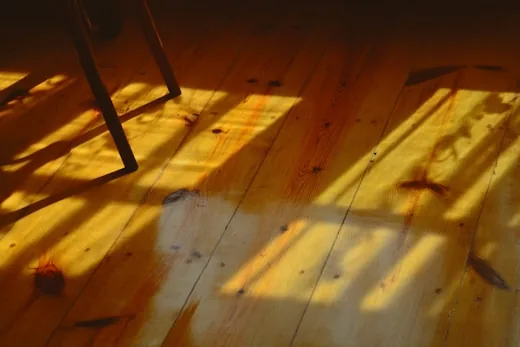 ComparisonPrefinished or site-finishedYou will be told the difference is dust and drying time. The difference that lasts is the bevel and whether the floor can ever be matched.
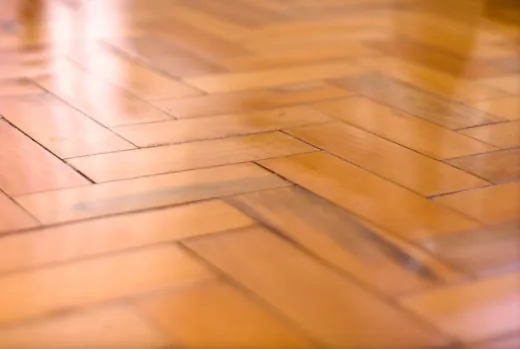 Pillar GuideRefinishing a floor in an old Philadelphia houseWhat decides whether your floor can be sanded, and why the answer here is different from the answer in a newer suburb.
 Decision GuideSolid or engineered, and why the basement decidesThe choice is presented as taste. It is usually settled by what is under the room, before anyone gets to taste.
Send a photo and we will tell you what you are looking at
Repair & Restoration starts with someone reading the house. We quote every job ourselves, with no salesperson in between, and a photo of the floor gets you a straight answer faster than a form does.
