The short version
- Parquet and herringbone cannot be sanded in one direction. They are sanded diagonally, then again on the opposite diagonal, and finished with a machine that has no grain direction.
- Much parquet is thinner than strip flooring. The remaining thickness is measured before anyone commits to a full sanding.
- Loose blocks are reglued, and missing ones are matched for species, thickness and proportion, starting with salvage from a closet in the same house.
- Old parquet adhesive can be a black mastic that should not be sanded or scraped without testing.
- In our data at /data/, 138 of 635 places have 35 percent or more of their housing built before 1940, the stock where patterned floors were laid most often.
First identify which parquet you have
Parquet covers several different floors, from thick solid herringbone to thin glued tiles, and what can be done depends on which one is there.
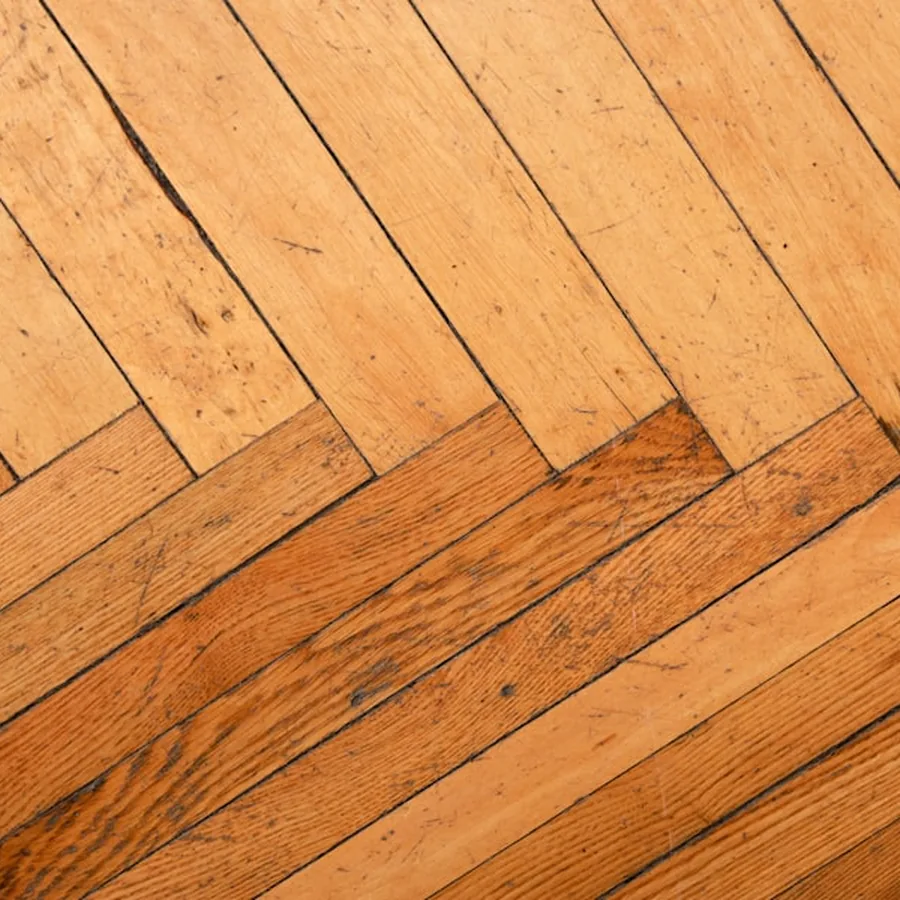
Herringbone is made of individual strips laid in a zigzag, each piece meeting the next at a right angle. In early twentieth century houses it is usually solid oak, nailed or set in adhesive, and thick enough to be sanded more than once.
Block parquet is made of squares, each built from several short slats, with the grain turned ninety degrees from one square to the next. The mid century version is often a thin tile, glued to the subfloor, and it has far less wood to work with.
There are also bordered floors, with a field of strip or herringbone framed by a band in a contrasting wood. The border is frequently the most valuable part and the thinnest, since the inlaid strips are often veneer thickness. Knowing which of these you have is the first step, and a photo taken straight down in daylight is usually enough for us to tell.
| Floor | How it was laid | What restoration usually involves |
|---|---|---|
| Solid herringbone | Individual strips, nailed or glued | Full diagonal sanding, pieces reglued or replaced as needed |
| Solid block parquet | Squares of short slats, glued or nailed | Diagonal sanding after loose blocks are secured |
| Thin tile parquet, mid century | Thin squares glued to the subfloor | Often one careful sanding at most. A recoat is the safer answer. |
| Bordered floor with inlay | Field of strip or herringbone with a decorative band | The border is measured separately. It is often the thinnest part. |
Why it cannot be sanded like a strip floor
Every piece meets its neighbor at ninety degrees, so any single pass with a sander cuts along the grain on half the floor and across it on the other half, and cutting across the grain tears the surface.
On a strip floor the machine runs with the boards and the whole room has one grain direction. A patterned floor does not offer that. Whatever line the sander takes, half the pieces are being cut the wrong way, and the result is rough, scratched wood that shows through the finish.
The method is to work diagonally, at forty five degrees to both grain directions, so no piece is cut fully across its grain. Then the direction is changed and the pass is repeated on the opposite diagonal, which evens out what the first one left.
The final passes are made with a machine that moves in a random or rotating pattern and has no direction of its own. It removes the diagonal scratches and leaves a surface that takes stain evenly. This is slower per square foot than any other sanding we do, and it is the reason many crews decline these floors.
If a contractor plans to sand a herringbone floor in straight passes along the room, the floor will show it. Ask how they intend to run the machine.
Measure before anything else
Parquet pieces are frequently thinner than strip flooring and may already have been sanded, so the wood remaining is measured before a full sanding is offered.
Some herringbone is three quarters of an inch thick and has plenty left. Much block parquet started at five sixteenths of an inch or less, with only a few millimeters above the joint between slats. One sanding may be all it can take, and a careless one is too many.
The measurement is taken where an edge is exposed: at a threshold, a floor register, or a block that has already come loose. A loose block is useful, since it shows the full thickness and what is underneath.
Where there is not enough wood for a full sanding, the conversation changes. A screen and recoat renews the finish without removing wood. Replacing a damaged section and blending it in is another option. Either is better than a sanding that ends the floor.
Loose blocks and missing pieces
Loose pieces are lifted, cleaned and reglued, and missing ones are replaced with wood matched for species, thickness and proportion.
Blocks come loose when the old adhesive fails, often after a leak or decades of seasonal movement. Regluing means lifting the piece, removing the old adhesive from both surfaces, and setting it in a modern flooring adhesive. Glue squeezed into the gap around a loose block does not hold.
Matching is where the time goes. A herringbone piece has a specific ratio of length to width. If a replacement is slightly off, the pattern does not close, and the error grows with every row. The species and the cut of the grain have to match as well, or the piece catches the eye.
The best source is the same house. Closets, the floor under a built in cabinet or beneath an appliance often hold pieces that can be moved to where they will be seen, with new wood going into the hidden spot. Where nothing can be salvaged, pieces are milled to the ratio and finished with the floor.
What is under the parquet
Old parquet was often set in a black bituminous adhesive, which should be left undisturbed or tested before it is scraped or sanded.
Lift a loose block in an older house and the back is frequently coated in a black, tar like mastic. Adhesives of that type from the middle of the twentieth century sometimes contained asbestos. Intact under a floor, it is not a hazard. Ground up by a sander or a scraper, it can be.
The practical rule is that the adhesive layer is not sanded. Where blocks need to come up over an area, a sample is tested by a laboratory first. New adhesive is chosen to be compatible with what remains on the subfloor.
In housing built before 1978 the federal lead rule also applies to painted baseboards and trim that the edger touches. In the dataset we publish at /data/, that is approximately 82.8 percent of Philadelphia's housing, and approximately 60.5 percent across the 635 places we cover.
Stain and finish on a patterned floor
A patterned floor shows sanding marks and uneven stain more than a strip floor does, so the surface preparation is finer and the color is tested on the floor itself.
Light hits a herringbone floor from two grain directions at once, which is what makes the pattern shimmer. It also means any scratch left by the sander is visible on half the pieces from wherever you stand.
Dark stains are the hardest. They collect in any scratch and emphasize it. Natural and light tones are more forgiving and usually suit these floors better, since the pattern itself is the decoration.
The finish is applied as on any floor, in coats, on the cure schedule of the product. Many owners of old parquet prefer a satin or matte sheen, which reads closer to the waxed finish these floors had originally.
When restoration is worth it, and when it is not
Restoration is worth it when most of the floor is present and thick enough, and it stops being worth it when large areas are missing, the wood is too thin, or water has lifted the pieces across the room.
A herringbone floor with a few loose pieces and a worn finish is a strong candidate. So is block parquet that was protected under carpet for decades. In both cases the pattern is intact and the work is sanding, a limited repair and finishing.
It becomes doubtful when a third of the floor is missing or damaged, or when a leak has swollen the pieces and broken the adhesive bond over a wide area. Thin tile parquet that has already been sanded once is another case where the honest advice may be to recoat it, or to replace it.
We say which at the estimate, after measuring. A patterned floor in good condition is one of the best features an old house can have, and it is worth an hour of someone's time to find out before it goes back under carpet.
Where these floors are found
Patterned floors were laid mostly in the formal rooms of houses built in the first half of the twentieth century, and in apartment buildings of the same period.
The dataset we publish at /data/ covers 635 towns and Philadelphia neighborhoods. In 138 of them, 35 percent or more of the housing was built before 1940, and 113 have a median home built before 1950. That is the stock where herringbone and bordered floors appear, typically in the living room, dining room and entry hall.
Mid century block parquet is found in a wider range: postwar apartments, split level houses and finished basements, often as a thin glued tile.
If you have lifted a carpet and found a pattern, do not pull up anything else yet. Photograph it from directly above, including any loose pieces and an exposed edge if there is one, and send it to us. That is usually enough to say what it is and whether it is worth a visit.