The short version
- Solid hardwood is nailed to a wood subfloor, which rules out slabs and below grade.
- Engineered is cross laid, so it stays flat where solid would cup, and it is the correct answer over concrete and radiant heat.
- The number that decides an engineered floor is the wear layer, not the total thickness.
- Concrete gets moisture tested before anything is glued to it, with a published method rather than a look.
- Across the 635 places in our data at /data/, the median year built ranges from the 1930s to the 2000s, and the newer stock is where slabs are common.
Start under the room, not with the sample
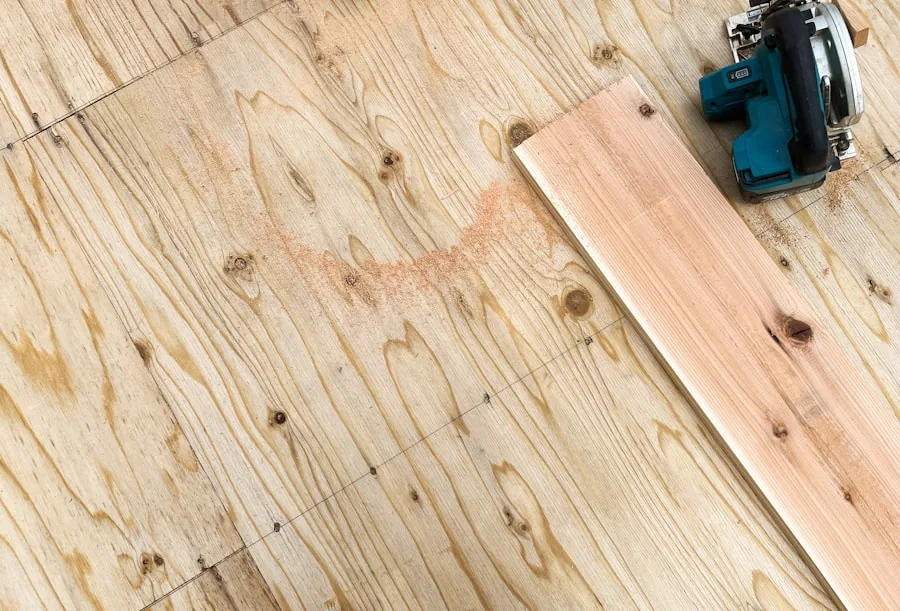
Solid hardwood is fastened through the tongue into a wood subfloor, so where there is no wood to nail into, solid is off the table before taste enters.
Nailing is not a preference, it is how the floor stays put while it moves. Wood takes on and gives off moisture with the air, and a solid board does that across its whole thickness: it grows in a humid August and shrinks in a dry February. The fastener through the tongue is what lets it do that without walking away from itself.
Over a concrete slab there is nothing to nail into. The workarounds mean gluing a floor that wants to expand, or building a wood subfloor on top, which costs headroom that a Philadelphia basement usually does not have.
Below grade the problem is not the fastener, it is the water. Concrete moves moisture from the ground into the room continuously, and a solid board sitting in that will cup and stay cupped.
In most of the housing here, main and upper floors are wood over joists, which is exactly what solid hardwood wants. Basements almost never are.
What engineered actually buys you
Cross laid plies restrain each other, so the board moves a fraction as much for the same change in moisture, which is what makes it correct over a slab, below grade and over radiant heat.
A solid board is one grain direction and swells across its width as a unit. An engineered board is layers glued at right angles, and each layer holds the next. That is the whole mechanism, and it is why the material exists.
The trade is thickness. The only real wood you will ever see or sand is the wear layer on top, and two floors that both say half an inch can have a four millimeter wear layer or a one millimeter veneer. One of them can be refinished and the other cannot, and the box rarely leads with that number.
So the question before buying is not the total millimeters. It is how many of them are above the core.
| Situation | What belongs there | Why |
|---|---|---|
| Main floor over joists | Solid, usually | Nailable, above grade, most refinishes |
| Concrete slab | Engineered | Nothing to nail into, and moisture from below |
| Below grade | Engineered | Continuous moisture through the slab |
| Over radiant heat | Engineered | Dried from below every winter |
| Bathroom or laundry | Neither. Vinyl or tile | Standing water is not a wood problem to solve |
The slab gets tested, not looked at
Concrete releases moisture long after it looks dry, and the industry answer is a measured test with a published procedure before anything is glued down.
A slab that feels dry on the surface can be well above the level an adhesive tolerates. The two established methods are relative humidity probes set into the slab and a calcium chloride test, and both exist precisely because appearance is not evidence.
The cost of skipping it shows up months later as adhesive failure or cupping, with the floor already down. It is one of the few places in this trade where a cheap test prevents an expensive redo.
Where the housing is newer, this comes up more often. Our data at /data/ carries the median year built for all 635 towns and neighborhoods, and the newer the stock, the more likely the ground floor is a slab rather than joists.
How to tell what is under your room
Look at the ceiling of the level below, lift a floor register, and consider when the house was built, and you will usually know whether the subfloor is wood or concrete.
If there is a basement under the room and its ceiling is open, look up. Joists with boards or plywood across them mean a wood subfloor. If the room is the lowest level of the house, or there is only a shallow crawlspace with no access, the answer needs a closer look.
A floor register is a small window into the floor. Lift the grille and look at the cut edge: layers of plywood, plank subfloor, or concrete are all visible there. Tapping works too. A wood framed floor sounds hollow, and a slab sounds dead.
The age of the house narrows it further. Older houses in this region are wood framed over a basement. Slab on grade becomes common in later construction and in additions, which is why a kitchen bumped out in the 1980s can sit on concrete while the rest of the house does not.
Three ways a wood floor is fastened
Solid hardwood is nailed, engineered wood can be nailed, glued or floated, and the method is chosen by the subfloor.
Nailing needs wood underneath. A fastener goes through the tongue of each board into the subfloor, and it is the traditional method for solid strip and plank.
Gluing bonds an engineered board directly to a slab or a wood subfloor with a flooring adhesive. It gives a solid feel underfoot and keeps the floor low, which matters where height is tight. The adhesive has a moisture limit, so the slab is tested first.
Floating means the boards lock or glue to each other and rest on an underlayment, attached to nothing below. It is the most forgiving method over a slab and the easiest to lift after a leak. It needs a flat base, since a floating floor flexes over any dip.
| Method | Works with | Needs |
|---|---|---|
| Nail down | Solid and engineered | A wood subfloor, above grade |
| Glue down | Engineered | A slab or subfloor within the adhesive's moisture limit |
| Floating | Engineered | A flat base and an underlayment suited to it |
The moisture numbers behind the decision
Before installation the flooring and the subfloor are metered, and the industry guideline allows a difference of four percentage points for narrow solid strip and two for plank.
Wood is installed at the moisture content it will live at, or it moves afterwards. The installation guidelines of the National Wood Flooring Association set the tolerance: for solid strip under three inches wide, flooring and subfloor within four percentage points of each other. For solid plank three inches and wider, within two.
The same guideline asks for at least twenty readings per thousand square feet. The purpose is to find the one wet area, since a single high reading in a corner tells you more than the average of the rest.
Engineered products follow the limits set by their manufacturer, and over concrete the slab test governs. In every case the principle is the same: the decision is made on readings.
Height, transitions and the room next door
A solid floor is about three quarters of an inch thick and many engineered floors are thinner, so the choice also decides whether the new floor meets the next room flush.
Where a new floor joins an existing solid one, matching thickness gives a flush joint with no threshold. An engineered board of the same thickness exists for that purpose, and thinner ones need the subfloor built up or a transition strip.
Height matters at more places than the doorway. Appliances have to slide back under counters, doors have to clear the floor, and the first and last steps of a stair change height when the floor at either end does.
We measure these at the estimate. A floor that is right for the subfloor and wrong for the dishwasher opening is still the wrong floor, and it is easier to choose a different thickness than to trim a row of doors.
How often each one can be refinished
A solid floor can be sanded four or five times over its life, and an engineered floor between a few times and never, depending on its wear layer.
On a solid board everything above the tongue is available for sanding, roughly a quarter inch. That is what gives a solid floor a working life measured in generations.
On an engineered board only the top layer is the species you chose. A thick wear layer takes two or three careful sandings. A thin one takes none, and when its finish wears through, the floor is replaced.
This is why two engineered products that look identical in a showroom are different purchases. Ask for the wear layer thickness in millimeters, and choose it on purpose.
Where each floor fits across the region
Older towns and neighborhoods are mostly wood framed and suit solid hardwood upstairs, and newer ones more often have slabs where engineered wood is the hardwood option.
The dataset we publish at /data/ gives the median year built for 635 towns and Philadelphia neighborhoods. In 113 of them the median home was built before 1950. Floors there sit on joists, and solid hardwood is the natural fit on the main and upper levels.
In 216 of them the median home dates from 1980 or later. Slab foundations and finished lower levels are more common, and engineered wood does the work that solid cannot.
Most houses need both answers somewhere. Solid upstairs and engineered in the basement or the addition, in the same species and finished to the same color, is a common and sensible result.